Why Sewage Cleanup in Deltona Demands a Fast, Professional Response
Deltona, Florida sits in the heart of Volusia County, a region shaped by subtropical weather, seasonal hurricanes, and afternoon thunderstorms that can drop inches of rain in under an hour. When floodwater enters your home or business, every minute counts. Standing water warps flooring, saturates drywall, corrodes electrical systems, and creates the warm, moist conditions that mold thrives in. In Deltona's average annual humidity of 74 percent, mold colonies can begin forming on wet surfaces within 24 hours of exposure.
At Deltona Water Restoration, we provide comprehensive sewage cleanup services designed for the specific challenges that Central Florida homeowners and business owners face. Our IICRC-certified technicians are on call 24 hours a day, 7 days a week, and we guarantee a 60-minute response time anywhere in the Deltona area. Whether you are dealing with a burst pipe in the middle of the night, a flooded garage after a summer storm, or catastrophic water intrusion from a hurricane, our team has the equipment, training, and local expertise to restore your property quickly and safely.
Common Causes of Flooding in Deltona, FL
Understanding the source of flooding is the first step toward effective cleanup and prevention. Deltona properties are vulnerable to several distinct types of flooding, each requiring a different approach to remediation.
Hurricane and Tropical Storm Flooding
Florida's hurricane season runs from June through November, and Deltona's inland location does not make it immune. While the city is roughly 25 miles from the coast, tropical systems regularly bring sustained rainfall, wind-driven rain intrusion, and rising water levels in local retention ponds and drainage systems. Hurricanes Irma (2017), Ian (2022), and other significant storms have caused widespread flooding across Volusia County, overwhelming storm drains and pushing water into homes that had never flooded before. Our storm damage repair services are specifically designed for post-hurricane recovery.
Plumbing Failures and Pipe Bursts
Many Deltona homes were built during the city's rapid growth in the 1980s and 1990s, and aging plumbing systems are a leading cause of indoor flooding. Polybutylene pipes, commonly installed in Florida homes during that era, are particularly prone to failure. A single burst supply line can release hundreds of gallons of water per hour into your home, damaging flooring, cabinetry, and structural framing. If you experience a sudden pipe burst, our emergency water removal service can be on site within the hour to stop the damage from spreading.
AC Condensate Line Clogs
In a state where air conditioning runs nearly year-round, clogged AC condensate drain lines are one of the most common causes of interior water damage. When the drain line backs up, water overflows from the drip pan and can seep into ceilings, walls, and flooring. Because the damage often starts in an attic or utility closet, it can go unnoticed until significant saturation has occurred.
Flash Flooding and Poor Drainage
Deltona's terrain is relatively flat, and much of the soil in the area contains a high percentage of clay, which drains slowly. Combined with the city's frequent heavy afternoon thunderstorms, this can lead to standing water around foundations, water intrusion through garage doors, and flooding of low-lying rooms. Properties near retention ponds or in flood zone areas are especially vulnerable during periods of sustained rainfall.
Understanding Flood Water Categories
Not all floodwater is the same. The Institute of Inspection, Cleaning and Restoration Certification (IICRC) classifies water damage into three categories, and each requires a different level of cleanup and precaution.
- Category 1 — Clean Water: Water from a sanitary source such as a broken supply line, faucet, or ice maker line. This water does not pose an immediate health threat but must be extracted and dried promptly to prevent it from degrading into Category 2 or 3.
- Category 2 — Gray Water: Water that contains chemical, biological, or physical contaminants. Sources include washing machine overflow, dishwasher leaks, and AC condensate. Gray water can cause illness if ingested and requires careful handling and disinfection.
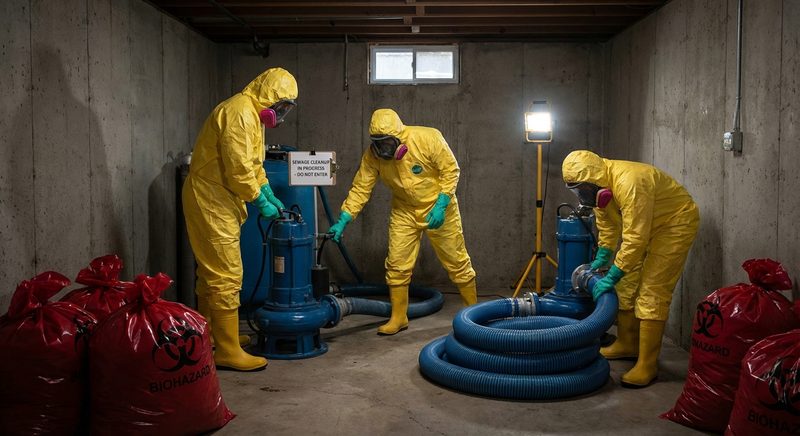
- Category 3 — Black Water: Grossly contaminated water that contains sewage, bacteria, viruses, and other pathogens. This includes sewage backups, floodwater from outside sources, and any standing water that has been stagnant for an extended period. Category 3 water requires full protective equipment, specialized extraction, and thorough decontamination. For extensive black water situations, see our dedicated sewage cleanup services.
One of the critical things homeowners need to understand is that clean water does not stay clean. In Deltona's warm climate, Category 1 water left standing for as little as 48 hours can degrade to Category 2 or even Category 3 as bacteria multiply. This is why rapid response is not just recommended — it is essential.
Our Sewage Cleanup Process
Our sewage cleanup process follows IICRC S500 standards and is tailored to the specific conditions found in Central Florida homes. Every project begins with a thorough assessment and ends with a documented final inspection to ensure your property is fully restored.
Step 1: Emergency Response and Assessment
When you call, our team is dispatched immediately. On arrival, we perform a comprehensive damage assessment using moisture meters, thermal imaging cameras, and visual inspection. We identify the water source, determine the water category, and map the full extent of moisture intrusion — including behind walls and under flooring where hidden saturation is common in slab-on-grade Deltona homes.
Step 2: Water Extraction
Using truck-mounted and portable extraction units, we remove standing water as quickly as possible. Our industrial-grade pumps can extract thousands of gallons per hour, significantly reducing drying time and preventing further damage to flooring, baseboards, and structural components.
Step 3: Structural Drying and Dehumidification
After extraction, we deploy commercial air movers, axial fans, and low-grain refrigerant (LGR) dehumidifiers throughout the affected area. Florida's high ambient humidity makes structural drying particularly challenging — standard fans alone are not enough. Our LGR dehumidifiers are designed to operate effectively even when outdoor humidity exceeds 80 percent, which is common in Deltona for much of the year. We monitor moisture levels daily and adjust equipment placement until every surface reaches its dry standard.
Step 4: Cleaning, Sanitizing, and Deodorizing
All affected surfaces are cleaned with antimicrobial solutions to eliminate bacteria and prevent mold growth. We treat soft contents such as upholstery, carpeting, and clothing where salvageable, and apply deodorizing agents to eliminate the musty odors that often linger after flooding. For Category 2 and 3 water events, we follow strict disinfection protocols that meet Florida Department of Health guidelines.
Step 5: Restoration and Reconstruction
Once the property is fully dried and sanitized, we handle any necessary reconstruction — replacing damaged drywall, baseboards, flooring, insulation, and cabinetry. Our goal is to return your property to its pre-loss condition, and we coordinate directly with your insurance adjuster to ensure the scope of repairs is properly documented and approved.
Flood Damage and Deltona's Common Construction Types
The majority of homes in Deltona are built with concrete block walls and stucco exteriors on concrete slab foundations. While this construction style is durable and well-suited to Florida's climate, it presents specific challenges during sewage cleanup. Concrete block can absorb and retain moisture for weeks if not properly dried, and the stucco exterior can trap moisture inside wall cavities where it is invisible from the outside. Slab-on-grade foundations mean there is no crawl space for water to drain into — when water enters, it has nowhere to go but into your flooring, baseboards, and bottom sections of drywall.
Our technicians understand these construction nuances and use specialized techniques — including wall cavity drying systems and injection ports — to ensure that moisture trapped inside block walls and behind stucco is fully eliminated, not just surface-dried.
Flood Insurance vs. Homeowners Insurance in Deltona
One of the most common and costly misconceptions among Deltona homeowners is the belief that their standard homeowners insurance policy covers all types of flooding. In reality, standard policies typically cover sudden and accidental water damage from internal sources — things like burst pipes, appliance failures, and accidental overflows. They do not cover natural flooding from storms, rising groundwater, or overflowing drainage systems.
For natural flood coverage, you need a separate flood insurance policy, either through the National Flood Insurance Program (NFIP) or a private flood insurer. Given Deltona's susceptibility to tropical storms and localized flash flooding, we strongly recommend that all homeowners carry flood insurance, even if their property is not located in a designated flood zone. FEMA data shows that approximately 25 percent of flood claims come from properties outside high-risk flood zones.
Regardless of your coverage situation, our team works directly with all major insurance carriers and can assist you with documentation, damage assessment reports, and the claims process to help maximize your coverage and minimize your out-of-pocket costs.
Need Sewage Cleanup in Deltona?
Our IICRC-certified team responds within 60 minutes, 24/7. Get a free estimate today.
Get Free Estimate →