In This Guide
- Why Hidden Water Damage Is Common in Deltona
- Sign 1: Water Stains and Discoloration
- Sign 2: Musty or Moldy Odors
- Sign 3: Peeling Paint or Bubbling Wallpaper
- Sign 4: Warped or Buckled Flooring
- Sign 5: Unexplained Increase in Water Bill
- Sign 6: Visible Mold Growth
- Sign 7: Soft Spots in Walls or Floors
- What to Do If You Find These Signs
- Why Florida Homes Are Especially Vulnerable
Why Hidden Water Damage Is Common in Deltona's Climate
Deltona sits in the heart of Central Florida, where afternoon thunderstorms roll through almost daily from May through October, annual rainfall averages over 50 inches, and humidity rarely drops below 60%. These conditions create a perfect storm—sometimes literally—for water damage that develops slowly and stays hidden until it becomes a major problem.
Unlike a catastrophic flood that announces itself immediately, hidden water damage is insidious. A tiny roof leak that only activates during heavy rain, a slow seep behind a shower wall, or condensation building up inside a poorly ventilated attic can cause thousands of dollars in damage before any visible signs appear. In Florida's climate, these small moisture intrusions are especially dangerous because the warmth and humidity accelerate deterioration, mold growth, and structural decay far faster than they would in cooler, drier regions.
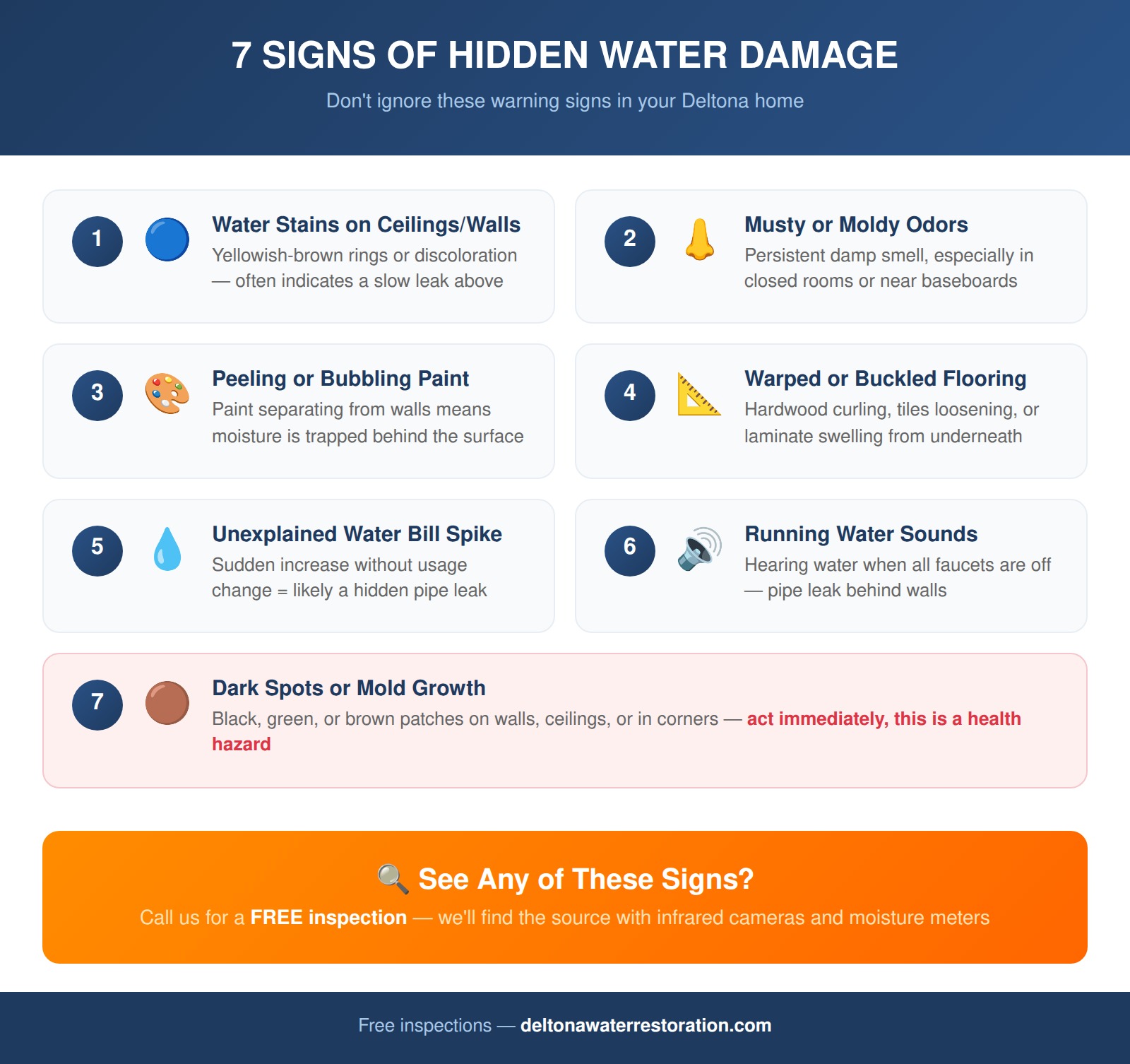
Knowing what to look for can save you a fortune. Here are the seven most common warning signs that water damage is hiding in your Deltona home.
Sign 1: Water Stains and Discoloration on Walls and Ceilings
Water stains are often the first visible evidence of a hidden leak, and they typically appear as yellowish-brown, copper, or dark patches on walls and ceilings. These stains occur when water seeps through building materials, carrying dissolved minerals and organic compounds that leave discolored residue as the water evaporates.
What to Look For
- Ceiling stains: Circular or irregular brownish marks, especially below bathrooms, near plumbing fixtures, or beneath the roofline. In Deltona's frequent rainstorms, roof leaks are a common culprit.
- Wall stains: Vertical streaks or spreading patches near windows, along baseboards, or around plumbing penetrations. Pay special attention to walls that back up to bathrooms or kitchens.
- Stains that grow or change: A stain that appears after rain and fades when it dries, or one that gradually expands over weeks, indicates an active leak that needs attention.
Don't make the mistake of simply painting over a water stain without addressing the source. The moisture behind that stain is continuing to damage your home's structure and creating ideal conditions for mold growth. If the stain is soft or damp to the touch, the underlying damage is likely more extensive than what's visible on the surface.
Sign 2: Musty or Moldy Odors
Your nose may detect water damage before your eyes do. A persistent musty, earthy, or damp smell—especially in enclosed areas like closets, cabinets, bathrooms, or under sinks—is a strong indicator that moisture and likely mold are present somewhere nearby.
Mold produces volatile organic compounds (VOCs) as it grows, and these compounds create that distinctive musty odor that most people associate with old basements or damp buildings. In Deltona homes, this smell often shows up in:
- Closets that share walls with bathrooms or exterior walls
- Under kitchen and bathroom sinks where slow leaks are common
- Laundry rooms, particularly around washing machine connections
- Garages with water heaters
- Rooms with exterior-facing walls where condensation can build up
If you notice a musty odor that intensifies when the air conditioning runs or when you enter a room that's been closed up, take it seriously. The smell means mold is actively growing somewhere, even if you can't see it. Professional mold remediation starts with identifying the moisture source, and a trained inspector can use thermal imaging and moisture meters to find the hidden problem.
Sign 3: Peeling Paint or Bubbling Wallpaper
When moisture accumulates behind a wall surface, it disrupts the bond between paint and drywall or between wallpaper adhesive and the wall. The result is paint that peels, flakes, cracks, or bubbles away from the surface, or wallpaper that lifts at the seams, develops bubbles, or starts to sag.
This sign is particularly telling because it indicates that moisture levels inside the wall have been elevated for some time—long enough to break down adhesion. In Deltona's humid climate, it's tempting to blame peeling paint on humidity alone, and sometimes that's the case in poorly ventilated bathrooms. But when you see peeling or bubbling in areas that should be dry—a bedroom wall, a hallway ceiling, or a living room corner—hidden water intrusion is the likely cause.
Common Causes in Deltona Homes
- A roof leak channeling water into the wall cavity during heavy rain
- A failed window seal allowing wind-driven rain to penetrate
- A pinhole leak in a copper supply line inside the wall
- Condensation from an improperly insulated HVAC duct
- Rising moisture from a slab foundation (known as "slab moisture" or "concrete moisture emission")
If you press on a bubbled area and feel give or dampness underneath, the wall material is compromised and needs professional assessment.
Sign 4: Warped or Buckled Flooring
Flooring is often the first casualty of hidden water damage because gravity pulls water downward, and floors are the lowest horizontal surface in any room. Different flooring materials respond to moisture in characteristic ways:
- Hardwood: Planks cup (edges rise higher than the center), crown (center rises higher than edges), or buckle entirely, lifting away from the subfloor. Even small amounts of persistent moisture can cause hardwood to deform permanently.
- Laminate: Seams swell, edges curl upward, and the surface develops a wavy or uneven appearance. Laminate is especially sensitive to moisture because its fiberboard core absorbs water readily.
- Tile: Tiles may loosen, crack, or develop hollow spots where the adhesive or thinset has been compromised by water. Grout may become discolored or crumble.
- Vinyl: Edges lift, seams separate, or the surface develops bumps and bubbles where moisture is trapped underneath.
- Carpet: Feels damp or spongy underfoot, develops stains from below, or produces a musty odor. Check along edges and seams where moisture tends to wick.
In Deltona homes built on slab foundations, moisture can migrate through the concrete slab itself—a phenomenon called moisture vapor transmission. This is a slow, ongoing process that can damage flooring over months or years without any obvious water event. If your flooring is warping in areas away from any plumbing, a slab moisture issue may be the cause.
Sign 5: Unexplained Increase in Water Bill
If your monthly water bill spikes without any change in your water usage habits, a hidden leak is one of the most common explanations. Even a small leak—a pinhole in a pipe, a slow drip behind a wall, or a cracked supply line under the slab—can waste hundreds of gallons per month and send your water bill climbing steadily.
How to Investigate
- Check your water meter: Turn off all water-using fixtures and appliances in your home. Go to your water meter and watch the dial. If it's still moving, you have a leak somewhere between the meter and your home or inside the house.
- Inspect obvious sources: Check all toilets (add food coloring to the tank and wait—if color appears in the bowl without flushing, the flapper is leaking), examine under-sink areas, and look at outdoor spigots and irrigation systems.
- Monitor over time: If you can't find an obvious source but the meter is showing usage with everything shut off, the leak is likely concealed inside a wall, under the slab, or underground between the meter and your home.
Slab leaks are particularly common in older Deltona homes where copper supply lines run through or beneath the concrete slab foundation. Soil conditions, water chemistry, and the age of the pipes can cause pinhole leaks that slowly saturate the soil and slab, eventually causing foundation damage, floor damage, and mold growth. A plumber or water damage restoration specialist can use acoustic listening devices and thermal imaging to pinpoint slab leaks without destructive testing.
Sign 6: Visible Mold Growth
Visible mold is both a sign of water damage and a problem in its own right. Mold requires moisture, organic material (such as drywall paper, wood, or carpet), and warmth to grow—and Deltona homes provide all three in abundance.
Mold commonly appears as black, green, white, or gray patches on walls, ceilings, window frames, tile grout, and other surfaces. In Florida's climate, mold can grow on surfaces that would remain dry in other parts of the country simply because the ambient humidity is high enough to sustain growth. However, when you see mold growing in living spaces—not just bathrooms—it almost always indicates a hidden moisture source that goes beyond normal humidity.
Where to Check for Mold in Deltona Homes
- Behind furniture against exterior walls: Air circulation is reduced, and condensation can form between the furniture and the wall.
- Inside closets, especially on exterior walls: Poor ventilation and cooled exterior wall surfaces create condensation points.
- Around window frames: Failed window seals allow moisture intrusion during Florida's frequent rainstorms.
- Under sinks and around plumbing penetrations: These are high-risk areas for slow leaks.
- In the garage, especially near the water heater: Water heater leaks can go unnoticed in garages that aren't frequently inspected.
- Around HVAC vents and ductwork: Condensation from poorly insulated ducts can cause persistent moisture and mold growth on adjacent surfaces.
Never attempt to remove mold that covers an area larger than about 10 square feet without professional help. Disturbing large mold colonies can release massive quantities of spores into your indoor air, potentially causing health problems and spreading the contamination to unaffected areas. Professional mold remediation uses containment, negative air pressure, HEPA filtration, and antimicrobial treatments to safely remove mold and prevent recurrence.
Sign 7: Soft Spots in Walls or Floors
Soft, spongy, or yielding areas in walls, floors, or ceilings indicate that the structural material has been compromised by prolonged moisture exposure. Drywall becomes soft and crumbly when saturated. Subflooring—typically plywood or oriented strand board (OSB)—can delaminate and lose its structural integrity. Ceiling materials sag and weaken, creating a potential collapse hazard.
How to Test for Soft Spots
Walk slowly across every room in your home, paying attention to any areas where the floor feels bouncy, spongy, or uneven underfoot. Press gently on walls and ceilings in areas near plumbing, below the roofline, and around windows. If the surface gives way more than it should, the material underneath has likely been weakened by water.
Soft spots in floors are especially concerning in Deltona homes because they can indicate damage to the structural subfloor, which in severe cases affects the stability of the floor system. In homes with wood-frame second stories, a soft spot in a second-floor bathroom could mean the subfloor is rotting from an undetected shower pan or toilet seal leak—a problem that will only get worse and more expensive to repair if left unaddressed.
Soft spots in walls near the base can indicate water wicking upward from the foundation—a condition sometimes called rising damp. In homes with stucco exteriors (common throughout Deltona), water can be trapped behind the stucco and wick into the interior wall surface, softening drywall from behind.
What to Do If You Find These Signs
Discovering potential water damage in your home is stressful, but taking prompt, methodical action can prevent the problem from growing and help you manage costs. Here's what to do:
- Stop the water source if possible. If you can identify the source of the leak—a dripping pipe, a running toilet, a failed supply line—shut off the water supply to that fixture or use your home's main shut-off valve.
- Document everything. Take photos and video of all visible damage, including close-ups of stains, mold, warped materials, and soft spots. This documentation is critical for insurance claims.
- Do not disturb mold. If you see visible mold growth, avoid touching it, scrubbing it, or spraying it with bleach. Disturbing mold releases spores that can spread contamination and affect indoor air quality.
- Contact a professional restoration company. A licensed, IICRC-certified restoration company can perform a thorough inspection using thermal imaging cameras, moisture meters, and other diagnostic tools to identify the full extent of damage—including areas you can't see.
- Review your insurance policy. Understand what your homeowner's insurance covers before filing a claim. Many hidden water damage situations are covered if they resulted from a sudden, accidental event. Damage from neglected maintenance or gradual deterioration is typically not covered. If you're unsure about costs, our guide to water damage restoration costs in Deltona provides detailed pricing information.
Why Florida Homes Are Especially Vulnerable
Florida homeowners face a unique combination of environmental and construction factors that make water damage more common and more problematic than in most other states.
Climate Factors
Central Florida's subtropical climate brings intense seasonal rainfall, frequent thunderstorms, and the ever-present threat of hurricanes and tropical storms. Deltona receives an average of 52 inches of rain per year, with the vast majority falling during the wet season from June through October. This volume of water constantly tests roofs, windows, foundations, and drainage systems.
Year-round humidity—averaging 74%—means that any moisture intrusion is slow to dry naturally. In drier climates, a minor roof leak might dry out between rainstorms without causing significant damage. In Deltona, that same leak creates a persistently moist environment that promotes mold growth, wood rot, and material degradation.
Construction Factors
Most Deltona homes are built with concrete block walls and slab-on-grade foundations—a construction style suited to Florida's soil conditions and hurricane resistance requirements. While concrete block is durable, it's also porous and can absorb and transmit moisture through capillary action. Water that enters through a crack in the stucco exterior, a failed window seal, or an improperly flashed roof-to-wall junction can migrate through the concrete block and emerge on the interior surface, often far from the original entry point.
Slab foundations eliminate crawl space flooding but introduce the risk of slab leaks and moisture vapor transmission through the concrete, which can damage flooring materials from below without any visible water event.
HVAC and Condensation
Florida homes run their air conditioning systems almost year-round, and the temperature differential between the cooled interior and the warm, humid exterior creates condensation risks on surfaces and inside wall cavities. Poorly insulated ductwork running through attics or unconditioned spaces can sweat profusely, dripping condensation onto ceiling materials and insulation. Over time, this condensation causes the same damage as a plumbing leak—stains, mold, and structural deterioration.
Being aware of these Florida-specific vulnerabilities and conducting regular inspections of your Deltona home can help you catch water damage early, when repairs are simpler and far less expensive. If you spot any of the seven signs discussed in this guide, don't wait—early intervention is always the most cost-effective approach.
Need Professional Water Damage Restoration in Deltona?
Our IICRC-certified team responds within 60 minutes, 24/7. Get a free estimate today.
Get Free Estimate →